Updated January 2026
A single failed delivery costs more than the redelivery attempt. There's the customer service time, the hit to your reputation, and often a lost customer who won't order again—84% of consumers won't purchase from a retailer again after just one negative delivery experience. For small businesses competing against retailers with sophisticated logistics operations, these failures add up fast.
AI changes the math by predicting and preventing delivery problems before they happen—validating addresses, optimizing routes in real time, and learning which time windows actually work for your customers. This guide covers how AI-powered delivery technology works, what it can realistically improve, and how to evaluate whether it makes sense for your business.
What is AI-powered last mile delivery
AI improves last mile delivery accuracy for small businesses by analyzing real-time data—traffic patterns, weather conditions, historical delivery outcomes, and customer availability—to generate precise route plans and accurate delivery windows. Rather than relying on static schedules or manual coordination, AI-powered systems continuously process information and adjust operations as conditions change.
Last mile delivery refers to the final leg of a package's journey, from a local distribution point to the customer's door. For most businesses, this stage represents 53% of total shipping costs and the greatest risk of something going wrong. A package might travel thousands of kilometres without incident, only to fail at the last few blocks because of an incorrect address or a missed time window.
AI applies three core technologies to solve last mile challenges:
- Machine learning: Algorithms that learn from past deliveries to predict future outcomes, like which addresses tend to have access issues or which time slots work best for specific neighbourhoods
- Predictive analytics: Tools that forecast problems before they happen, such as identifying when weather or traffic will likely cause delays
- Automation: Systems that handle repetitive tasks like sending notifications, validating addresses, and adjusting routes without human intervention
Why small businesses need AI to compete on delivery accuracy
Customer expectations around delivery have changed dramatically over the past few years. Same-day and next-day shipping, once considered premium services, are now standard offerings from major retailers. Small businesses competing for the same customers face pressure to match this reliability, often without dedicated logistics staff or enterprise-level technology budgets.
The financial impact of delivery failures hits small businesses particularly hard. Each failed attempt means additional fuel costs, driver time, and customer service hours—averaging $17.78 per failure. Beyond the direct expenses, there's the harder-to-measure cost of lost trust—customers who experience a poor delivery often don't come back.
AI helps level the playing field. While large retailers built custom logistics infrastructure over many years, cloud-based AI delivery platforms now offer similar capabilities at accessible price points. A small e-commerce shop can access the same route optimization and predictive scheduling that major carriers use, without building anything from scratch.
How AI validates and corrects delivery addresses
Address errors cause 45% of failed deliveries. Typos, missing apartment numbers, outdated postal codes, and ambiguous location descriptions all lead to packages that can't reach their destination on the first try.
Automated address verification
AI cross-references entered addresses against postal databases the moment an order comes in. If a customer types "123 Main St" but forgets their unit number, the system flags the issue immediately. This verification happens in milliseconds, catching problems that would otherwise surface hours later when a driver is standing at the wrong building.
The process works by comparing each address component—street number, street name, city, postal code—against known valid combinations. When something doesn't match, the system can either auto-correct obvious errors or prompt the customer to confirm their information before the order processes.
Geocoding for precise location accuracy
Geocoding converts text addresses into exact latitude and longitude coordinates. This matters especially in rural areas, new housing developments, or commercial complexes where standard mapping services struggle to pinpoint the right entrance.
Think of it this way: "123 Industrial Park Drive" might technically be correct, but without geocoding, a driver could end up at the main gate rather than the specific loading dock where deliveries are accepted. AI systems that incorporate geocoding route drivers to the actual delivery point, not just the general vicinity.
Reducing manual entry errors
When customers place orders by phone or staff transcribe handwritten notes, mistakes happen. AI auto-completes addresses as they're typed and standardizes formats automatically. Abbreviations get expanded, postal codes get validated, and common misspellings get corrected before they cause problems downstream.
How AI optimizes delivery routes to reduce failed attempts
Smart routing does more than save fuel—it directly affects whether packages arrive within promised windows. When drivers follow optimized routes, they're more likely to reach each stop on time, which means customers are more likely to be home and available to receive their orders.
Dynamic routing based on traffic conditions
Static routes planned the night before can't account for a morning accident or unexpected road closure. AI-powered routing adjusts in real time, rerouting drivers around delays as conditions change throughout the day.
The delivery window you promised at checkout stays accurate even when traffic patterns shift. Instead of a driver sitting in gridlock while their schedule falls apart, the system recalculates and finds an alternative path.
Multi-stop route sequencing
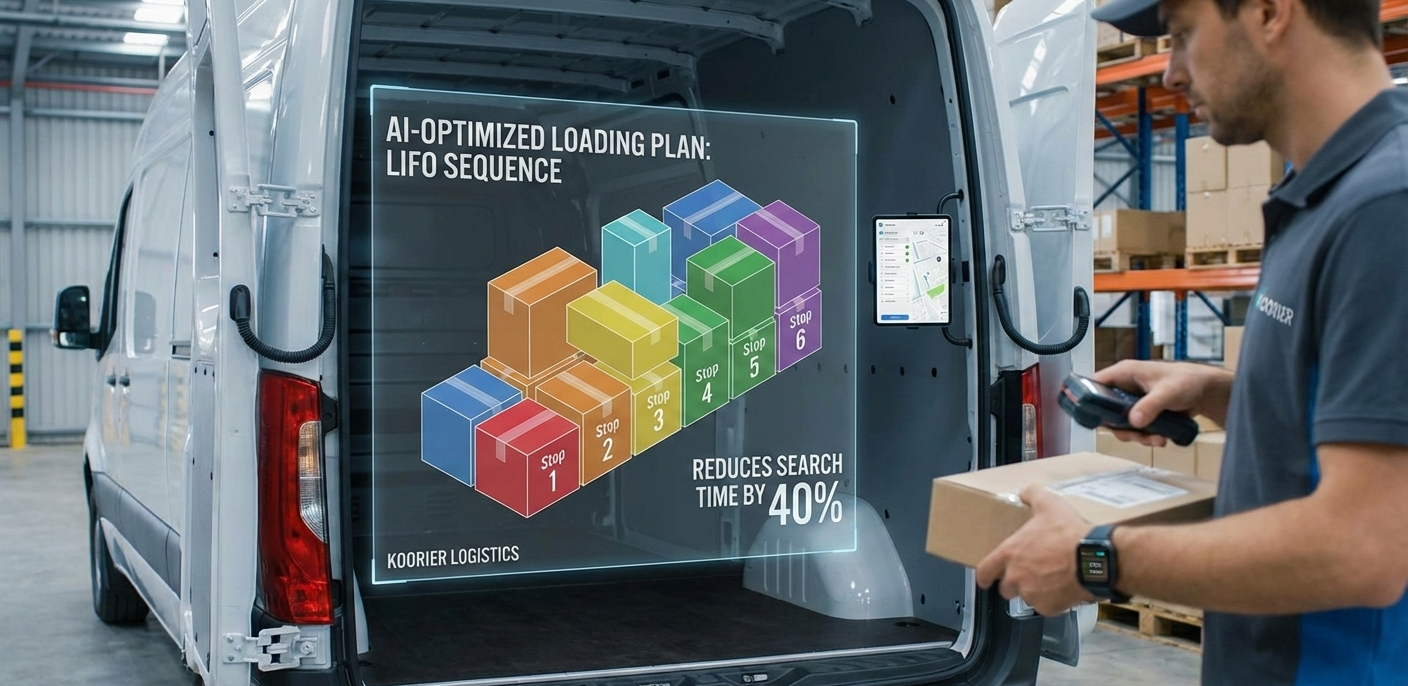
For drivers making dozens of deliveries, the order of stops matters enormously. AI calculates the most efficient sequence by considering distance, time windows, traffic patterns, and even which side of the street each address sits on.
What looks like a minor optimization per stop—saving two minutes here, three minutes there—compounds into significant time savings across a full route. More importantly, it keeps the entire schedule on track rather than letting early delays cascade into later missed windows.
Weather and road condition adjustments
AI factors in weather forecasts and reported road conditions before they affect deliveries. If snow is predicted for a particular area, the system can adjust ETAs proactively or suggest earlier delivery attempts.
This forward-looking approach prevents the common scenario where a driver heads into deteriorating conditions, falls behind schedule, and ends up with multiple failed deliveries because customers weren't expecting the delay.
How real-time AI tracking improves delivery visibility
Visibility and accuracy are closely connected. When businesses and customers know exactly where a package is, coordination improves and failed attempts decrease.
GPS and IoT integration
IoT devices—sensors and connected hardware attached to vehicles and packages—provide continuous location data throughout the delivery journey. Rather than periodic updates at major checkpoints, you get a live view of every package in transit.
Platforms like Koorier One integrate this tracking directly into existing business workflows, so you're not switching between multiple systems to monitor deliveries.
Automated status updates
AI triggers notifications at key milestones without requiring drivers to manually check in. When a package leaves the warehouse, arrives in the delivery area, or gets handed off, the system updates automatically.
This consistency builds customer trust and reduces "where's my package?" inquiries. Customers who receive regular, accurate updates are less likely to contact support and more likely to be available when their delivery arrives.
Accurate proof of delivery
Photo capture, digital signatures, and GPS-stamped timestamps provide confirmation that eliminates disputes. If a customer claims they never received a package, you have documentation showing exactly when and where it was delivered.
This proof also helps identify patterns—if deliveries to a particular address frequently show photos of packages left in unsecured locations, you can flag that address for special handling instructions.
How AI predicts the best delivery time windows
Delivering when customers are actually available dramatically increases first-attempt success rates. AI makes this prediction possible at scale by analyzing patterns that would be impossible to track manually.
Historical delivery data analysis
AI learns from patterns in past deliveries. Certain neighbourhoods might have higher success rates in the evening when residents are home from work. Business addresses typically accept deliveries during standard hours but not during lunch breaks.
The system identifies these patterns automatically and applies them to future scheduling without anyone having to manually configure rules for each area.
Customer availability patterns
Over time, machine learning identifies individual customer behaviour. If a particular customer has accepted three deliveries between 6-8 PM but missed two attempted during work hours, the system learns to prioritize evening windows for their address.
This personalization happens in the background. Customers don't have to set preferences or fill out forms—the system simply learns from their history and adjusts accordingly.
Dynamic ETA adjustments
Estimated arrival times aren't static. AI continuously recalculates based on how the route is progressing and communicates updates to recipients.
A customer who knows their package will arrive in 20 minutes can plan to be available. A vague "sometime today" window, on the other hand, often leads to missed deliveries because customers can't structure their day around an uncertain timeframe.
How AI automates delivery exception management
Delivery exceptions—failed attempts, access issues, unavailable recipients—happen even with careful planning. AI handles these situations without requiring manual intervention for every problem.
Automatic rerouting after failed attempts
When a delivery can't be completed, AI immediately determines the next best action. The package might get rescheduled for later that day, redirected to a nearby pickup location, or queued for the next morning's first route.
This happens automatically rather than waiting for someone to notice the failed attempt, decide what to do, and manually update the system.
Proactive customer notifications
AI detects potential issues before they become failed attempts. If a driver is running significantly behind schedule, the system can alert the customer and offer options: reschedule for a different time, provide alternate delivery instructions, or authorize a safe drop location.
This proactive communication often prevents failures entirely. A customer who knows their delivery is delayed can make arrangements, while a customer who's surprised by a "sorry we missed you" notice has no opportunity to help.
Exception trend analysis
Patterns in delivery failures reveal opportunities for improvement. If a particular apartment building consistently causes problems because the buzzer system is unreliable, AI flags it so you can add special instructions for that address.
Similarly, if certain time windows have higher failure rates across your delivery area, the system adjusts its recommendations to avoid scheduling during those periods.
How AI helps small businesses scale delivery operations
Growth often breaks manual processes. What worked for 20 daily orders becomes chaotic at 200. AI maintains accuracy even as complexity increases, which allows businesses to grow without proportionally increasing their logistics overhead.
Handling higher volumes without more staff
Automation manages the increased coordination that would otherwise require additional dispatchers or coordinators. Route optimization, customer communication, and exception handling all scale without adding headcount.
A single person monitoring an AI-powered system can effectively manage what previously required a team, freeing up resources for other parts of the business.
Seamless e-commerce platform integration
AI delivery systems connect with Shopify, WooCommerce, and other platforms to automatically import orders. No manual data entry, no copy-paste errors, no delays between order placement and dispatch planning.
When a customer completes checkout, their order flows directly into the delivery system and gets incorporated into route planning immediately.
Maintaining accuracy during growth
AI systems adapt to new delivery zones and increased stop counts without degrading performance. The algorithms actually improve with more data, meaning accuracy often increases as your business grows rather than declining under the strain of higher volume.
How to choose an AI delivery solution for your small business
Not all AI delivery tools serve small businesses equally well. Some platforms are designed for enterprise volumes and don't make economic sense until you're shipping thousands of packages monthly. Others lack the integration capabilities that make AI useful in the first place.
1. Evaluate integration capabilities
Check compatibility with your existing e-commerce platform, inventory system, and customer communication tools. The best AI features won't help if they create data silos or require manual workarounds to connect with your other systems.
2. Assess scalability
Ensure the solution can handle volume increases during peak seasons. Ask specifically about performance during high-demand periods and whether pricing scales reasonably as your order count grows.
3. Compare pricing for small volumes
Look for solutions designed for small business order volumes rather than enterprise-focused platforms with high minimums. Pay-per-delivery pricing often works better than flat monthly fees for businesses with variable shipping volumes.
4. Review real-time tracking features
Prioritize solutions offering live visibility for both your team and your customers. The ability to see exactly where every package is—and share that information automatically—directly reduces failed deliveries and support inquiries.
Common myths about AI delivery technology for small businesses
Several misconceptions prevent small businesses from adopting tools that could significantly improve their delivery operations.
AI is only for large enterprises
Cloud-based delivery platforms have made AI accessible at price points that work for small businesses. You don't need a dedicated IT team or custom infrastructure—modern solutions are designed for businesses shipping dozens of packages daily, not just thousands.
The same algorithms that optimize routes for major carriers are now available through software-as-a-service platforms that charge based on usage rather than requiring large upfront investments.
Implementation is too complex
Most AI delivery tools offer straightforward setup processes. If you can connect your e-commerce platform to a shipping app, you can implement AI-powered delivery optimization. The technical barriers that existed several years ago have largely disappeared as platforms have matured.
Typical implementation involves connecting your order source, configuring basic preferences like delivery windows and notification templates, and then letting the system learn from your delivery patterns over time.
AI replaces human oversight
AI augments human decision-making rather than eliminating it. Your team focuses on exceptions and customer relationships while AI handles routine optimization. The goal is freeing up human attention for situations that actually require judgment and creativity.
When something unusual happens—a customer with a complex request, a delivery that requires special handling—humans step in. For the routine work of optimizing routes and sending updates, AI handles the volume.
Build a smarter delivery network with the right partner
Delivery accuracy isn't a luxury for small businesses—it's a competitive requirement. AI makes enterprise-level logistics capabilities accessible without enterprise-level budgets or the complexity of building custom systems.
The technology handles the variables that traditionally made accurate delivery difficult: traffic, weather, address errors, and customer availability. What remains is a delivery experience that builds customer trust and encourages repeat purchases.
Request a shipping quote from Koorier to see how AI-powered logistics can work for your business.
Author & Authority
By Avinash Anand
Logistics analyst with 25+ years of experience in Canadian last-mile delivery optimization.
About Koorier
Koorier has helped Canadian merchants design and operate regional delivery networks since 2021.
FAQs about AI and last mile delivery accuracy
How much does AI delivery software typically cost for small businesses?
Most AI-powered delivery platforms offer tiered pricing based on shipment volume. Entry-level plans designed for small business budgets typically range from $50-150 monthly, with pay-per-delivery options available for businesses with variable order volumes.
What data does AI delivery software need to improve accuracy?
AI systems require order details, delivery addresses, and historical delivery outcomes to optimize routes and predict successful delivery windows. The more delivery data the system processes over time, the more accurate its predictions become for your specific customer base and delivery areas.
How long does it take to implement AI delivery technology?
Cloud-based delivery platforms can typically be set up within a few days. Most small businesses become operational after connecting their e-commerce platform and configuring basic preferences—no lengthy implementation projects or technical expertise required.
Can AI delivery solutions work with carriers a small business already uses?
Many AI delivery platforms are carrier-agnostic, allowing businesses to maintain existing carrier relationships while adding optimization and tracking capabilities. The AI layer sits on top of your current shipping arrangements rather than replacing them entirely.
What order volume makes AI delivery software worthwhile?
AI delivery tools can benefit businesses at relatively low volumes. Even a modest reduction in failed deliveries and customer service inquiries typically offsets subscription costs, making the investment reasonable for businesses shipping as few as 30-50 packages weekly.

.png)