Updated February 2026
Delivery route planning software is the engine behind faster, cheaper, and more reliable last-mile operations. Instead of dispatchers manually building routes (or drivers figuring it out on the fly), modern platforms use algorithms, live data, and AI to plan the most efficient paths for every stop. For high-volume e-commerce and courier operations, this isn’t a “nice to have” anymore—it’s how you hit delivery windows, control costs, and keep customers happy.
At Koorier, route planning sits at the heart of the delivery stack: orders flow in, routes are optimized in real time, and drivers get turn-by-turn guidance that adapts to traffic, weather, and changing delivery priorities.
The Core Problem Route Planning Solves
Route planning software tackles a classic optimization challenge: how to deliver the most packages, with the fewest miles, in the least amount of time, while respecting real-world constraints (time windows, vehicle capacity, service areas, driver shifts, and customer availability). In operations research, this is often modeled as the Vehicle Routing Problem (VRP)—a family of problems that grows exponentially complex as stops increase.
Modern systems combine fast heuristics with optimization solvers to produce practical routes in seconds, even for hundreds or thousands of stops. If you want a technical overview of VRP and how routing engines solve it at scale, Google’s open-source OR-Tools documentation offers a solid primer on real-world routing constraints and solvers (Google, 2024).
How Route Planning Software Works (Step by Step)
1) Ingests orders and constraints
The system pulls in delivery addresses, promised time windows, package sizes, service times, driver shifts, vehicle capacities, and priority flags. Koorier centralizes these inputs so planners don’t juggle multiple tools.
2) Builds a digital map of reality
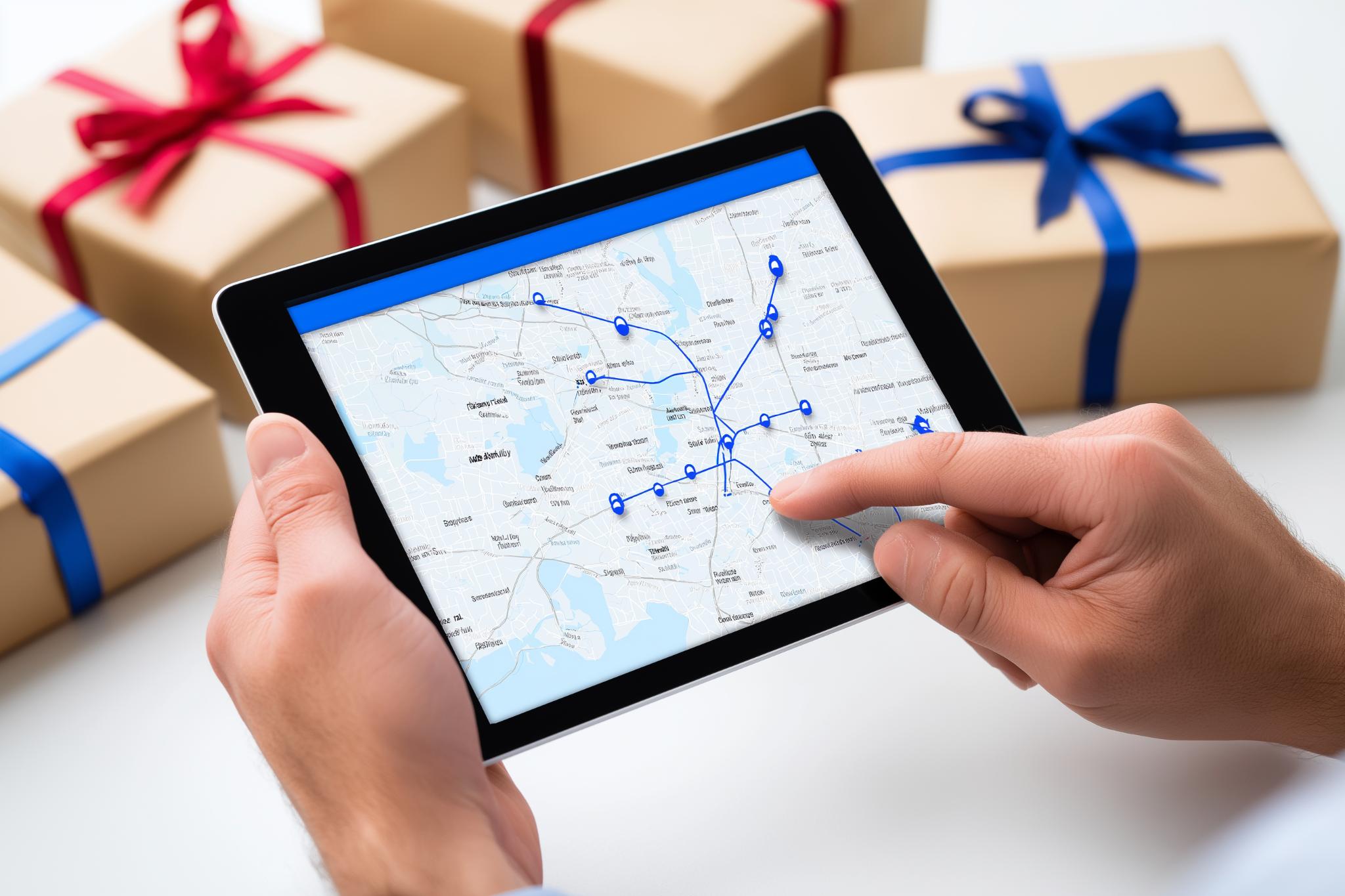
Routes are planned on top of road networks enriched with live and historical data—traffic patterns, turn restrictions, typical congestion by time of day, and distance/time matrices. Mapping platforms like Esri outline how routing engines factor network constraints and travel times into route calculations (Esri, 2024).
3) Runs optimization algorithms
The engine evaluates millions of possible route combinations and selects near-optimal plans that minimize cost (time, distance, fuel) while respecting constraints. Modern platforms blend heuristics (fast, good-enough) with optimization solvers (precise, compute-heavy) to strike the right balance for same-day planning.
4) Dispatches routes to drivers
Optimized routes are pushed to driver apps with stop sequences, ETAs, and navigation. With Koorier, dispatch happens in one click, and updates propagate instantly to drivers and customer-facing tracking.
5) Adapts in real time
When traffic spikes, a customer becomes unavailable, or a high-priority order drops in, the system recalculates routes mid-day. This is where AI-assisted routing shines—continuous re-optimization prevents missed windows and failed delivery attempts.
What “Good” Route Planning Software Must Handle
The Role of AI in Modern Route Planning
Traditional routing engines optimize for distance and time. AI-enhanced systems go further by learning from outcomes:
- Predictive ETAs: Models learn typical service times per stop and congestion patterns by neighborhood and time of day.
- Risk scoring: Stops with historically higher failure rates can be scheduled earlier or paired with proactive customer notifications.
- Continuous improvement: The system refines itself as more delivery data flows in.
IBM outlines how AI and analytics are used in logistics to improve routing decisions, resilience, and operational performance (IBM, 2024).
Koorier applies these principles by learning from your historical delivery data to tighten ETAs, reduce reattempts, and improve first-attempt success—especially important for same-day and time-windowed deliveries.
Why Route Planning Software Matters (Business Outcomes)
- Lower delivery costs: Fewer miles, less fuel, and tighter routes reduce cost per stop.
- Higher on-time performance: Time-window optimization improves customer satisfaction and SLAs.
- Fewer failed delivery attempts: Dynamic re-routing and predictive timing reduce missed recipients.
- Operational scalability: Automated planning handles peak volumes without burning out dispatch teams.
- Sustainability gains: Shorter routes mean lower emissions—an increasing priority for Canadian e-commerce.
How Koorier Delivers Route Planning at Scale
Koorier’s route planning software is built for real-world last-mile complexity:
- AI-driven optimization that balances speed, cost, and reliability across thousands of daily stops.
- Real-time re-routing when conditions change—traffic, weather, or last-minute order inserts.
- Native proof-of-delivery and analytics so every route feeds continuous improvement.
- Multi-hub orchestration to route orders from the closest inventory node, shrinking last-mile distance.
- Customer visibility with accurate ETAs and live tracking that reduces support tickets.
The result: tighter routes, fewer exceptions, and a delivery operation that actually improves over time.
Common Pitfalls (and How to Avoid Them)
- Static routes: Planning once per day ignores real-time reality. Use continuous re-optimization.
- Ignoring service times: Underestimating stop time leads to late deliveries. Train models on real data.
- Poor data hygiene: Bad addresses and incomplete constraints produce bad routes. Validate inputs upstream.
- Siloed systems: Routing that doesn’t talk to dispatch, POD, and customer comms creates friction. Use an integrated platform like Koorier.
Plan Smarter Routes Today
If your dispatch team is still building routes manually—or your drivers are fighting traffic without real-time support—you’re leaving money and customer satisfaction on the table. Koorier’s AI-powered route planning helps you cut miles, hit delivery windows, and scale same-day operations without chaos.
Request a demo to see how optimized routing can transform your last-mile performance in 2026 and beyond.
Author & Authority
By Giovanna Freitas
Marketing specialist at Koorier
About Koorier
Koorier is a Canadian logistics technology company specializing in regional last-mile delivery networks and real-time delivery visibility for retailers and enterprises.
Frequently Asked Questions (FAQ)
Q1: What’s the difference between route planning and route optimization?
A: Route planning builds feasible routes; route optimization mathematically improves them to minimize time, distance, or cost under constraints.
Q2: Can route planning software adjust routes during the day?
A: Yes. Modern systems recalculate routes in real time based on traffic, exceptions, and new orders—crucial for same-day delivery.
Q3: Is route planning software only for large fleets?
A: No. Cloud platforms scale from small fleets to enterprise operations. Koorier supports growth without adding dispatcher overhead.

.png)